The afternoon sun slanted across the kitchen table, catching the edges of a crumpled math worksheet and two half-eaten chocolate frosted donuts. Nate leaned forward with a pencil behind his ear, pointing to a fraction while Olivia frowned, her knuckles resting lightly near his sleeve.
For the first time in weeks, the air in our house didn’t feel brittle. It didn’t feel like we were walking on eggshells around a grief that had already been spoken out loud. Even Mark, who had spent the morning wiping down the same fender of the truck three times just to keep his hands busy, looked up from the back porch with an expression closer to quiet acceptance than anger.
“Okay,” Olivia sighed, dropping her pencil onto the paper. “I still hate algebra. And I still hate that I have to take a nap after twenty minutes of it.”
“That’s because your brain is running on chemo fumes,” Nate said without missing a beat. “We can pause. Nobody’s grading this today.”
“I’m grading it,” she muttered, though the corner of her mouth twitched upward. “If I don’t keep up now, I’ll drown next month.”
I stood by the sink, watching them. It was strange how ordinary it looked—two teenagers arguing over homework at a kitchen table—and how fiercely precious that ordinariness had become. Only a month ago, I had watched her stare at strands of her own hair on the bathroom floor, asking if anything good would ever happen again.
Later that afternoon, after Nate had gone home promising to bring flashcards on Wednesday, Olivia lingered by the hallway mirror. She didn’t put on a hat or reach for a scarf. She just tilted her head, looking at the pale curve of her scalp and the faint dark circles under her eyes.
“Mom,” she said softly. “Do you think people at school are still talking about prom?”
I walked over and stood beside her, meeting her eyes in the glass. “Probably for a little while. High schoolers love a story.”
“And what do you think they’re saying now?”
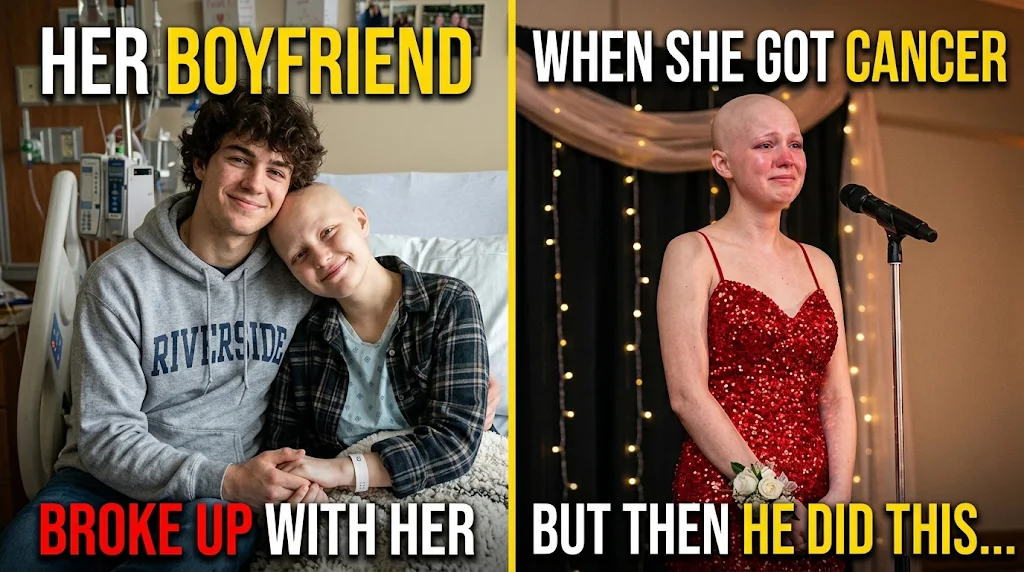
I thought about the gymnasium—the quiet that had fallen over the crowd when the truth came out, the way students had stepped back to give them room on the dance floor, and the look on Nate’s face when he stood his ground without asking for applause.
“I think,” I told her, “they’re realizing that sometimes the people who look the most out of place are the only ones telling the truth.”
Olivia let out a slow breath and leaned her weight against my arm. “Nate looked kind of good in purple,” she admitted, almost under her breath. “In a completely ridiculous way.”
“Don’t tell your dad I agreed with you,” I said, squeezing her hand.
“Deal.”
She went to her room early that evening, leaving the door cracked open—a small change, maybe, but one that meant she wasn’t locking the rest of the world out quite as hard as she used to. Downstairs, Mark sat on the sofa with a mug of coffee gone cold, staring at his phone.
“You’re quiet,” I said, sitting beside him.
“Just thinking about what he said on Friday,” Mark murmured. “About how she didn’t want to be watched like she was already gone.” He looked over at me, his jaw tight. “I’ve been watching her like a hawk since the day they told us. Every time she coughs, every time she gets quiet, I’m waiting for the worst.”
“I know you have.”
“What if I’m making her feel smaller without meaning to?” he asked, and for once, the tough exterior he wore around everyone else was completely gone.
I reached over and took his hand. “Then we learn how to hold on tight without suffocating her. We let her be seventeen whenever she has the energy for it.”
Mark nodded slowly, staring down at our joined hands. “Alright. Tomorrow, I’m making pancakes. And I’m not asking her how her stomach feels unless she brings it up.”
“That sounds like a very good start.”
The days after prom didn’t magically erase the hospital visits, the blood draws, or the heavy, bone-deep fatigue that followed every treatment. Cancer didn’t care about a high school dance or a change of heart. There were still mornings when Olivia couldn’t lift her head off the pillow until noon, and nights when fear crept into the quiet hours like a cold draft.
Yet something fundamental had shifted. The secret was gone, and with it went the exhausting performance of pretending everything was fine—or pretending nobody cared. When Nate came over after school, he didn’t act like a savior or a martyr. He sat on the edge of her bed, complained about their history teacher, brought her cold fruit she could actually stomach, and stayed until she fell asleep.
One evening three weeks later, as twilight settled over the yard, I found Olivia sitting on the back steps with a blanket wrapped around her shoulders. The breeze carried the scent of cut grass and spring rain.
“Hey,” I said, sitting down beside her. “Thought you were resting.”
“I was,” she said, looking out toward the darkening trees. “Then I remembered I hadn’t told you something.”
“What’s that?”
“Nate asked if I wanted to go to the beach in two weeks. Just for the afternoon, if my counts are good.” She glanced at me, a flicker of hope—cautious, guarded, unmistakably real—in her eyes. “He said he’d drive slow and bring an umbrella so I don’t get too much sun.”
I smiled, feeling a familiar tightness in my chest, though this time it wasn’t from sorrow. “What did you tell him?”
“I told him I’d ask you first.” She paused, looking down at her hands. “I’m still scared, Mom. A lot of the time. I don’t know what’s going to happen next.”
“I don’t either, baby,” I said, wrapping an arm around her shoulders and pulling her close. “Nobody ever really does. We just take the next step we can see.”
Olivia leaned her head against mine, watching the first stars blink awake above the yard. “Yeah,” she whispered. “Okay. Let’s see what happens next.”